Derek Simmons
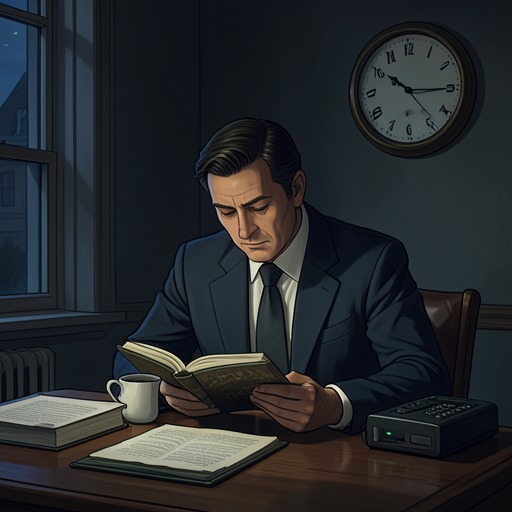
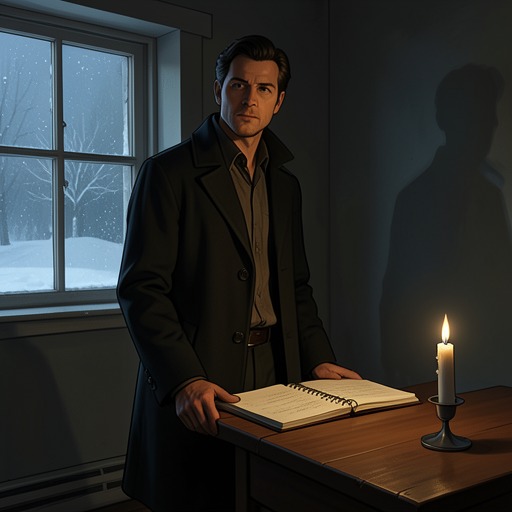
The Book of MirrorsDerek Simmons is a maintenance worker and former psychiatric patient whose fractured memory connects the murder of his wife, Anne, to the later killing of Joseph Wieder. Wieder’s care gave him a precarious life outside an institution, but it also placed him near the professor and the events surrounding the murder. Simmons eventually identifies Richard Flynn as Wieder’s killer and implicates Laura Baines as a possible witness or accomplice; discrepancies in his accounts, and doubts about whether his amnesia was genuine or persistent, keep his testimony from settling the case.
Identity and Background
Simmons and Anne had been married for five years and had no children. He worked as a maintenance man; Anne was a waitress at a coffee shop on Nassau Street. Neighbours and friends later described the couple as happy and said they had never seen them argue. That public impression sits uneasily beside Simmons’s later account of jealousy, infidelity, and violence, none of which can be treated as independently established fact.
On the morning Anne died, Simmons called an ambulance and said she was seriously hurt. Paramedics found her lifeless in the hall, in a pool of blood, with repeated stab wounds to her neck and chest. Simmons’s initial account, as reported in the investigation, was that Anne came home at 1:12 a.m., argued with him after he accused her of an affair, and may have said she intended to seek a divorce. He said that about two hours later he took a kitchen knife and killed her, disposed of the weapon, and called for an ambulance as though he had just discovered her body. He was arrested on a murder charge, but continued to claim innocence and refused a deal while his attorney pursued an insanity defense.
Diagnosis, Hospitalization, and a Reconstructed Life
After examining Simmons repeatedly, Joseph Wieder concluded that he had a dissociative disorder involving fugue states, and had been wrongly diagnosed with schizophrenia when young. Wieder’s explanation was that a person in such a state might lose self-awareness, memory, and identity, sometimes living under a different identity without recollection of an earlier life. He considered it possible that Simmons had not remembered what he did on the night Anne died, if stress and the transition from sleep to waking had triggered such a state. Wieder’s report persuaded the court to commit Simmons to Trenton Psychiatric Hospital. With the institution and his lawyer’s agreement, Wieder continued treating him, using hypnosis and an experimental mixture of anticonvulsant drugs.
After a year, Wieder arranged Simmons’s transfer to Marlboro Psychiatric Hospital, where conditions were less strict. Wieder helped reconstruct his personality, but the recovery was incomplete: Simmons could write and do electrical work without remembering school or how he had learned his trade. His memories before an attack in the hospital remained inaccessible. A judge approved his discharge in the spring of 1985, in part because the case was complex and he showed no violent tendencies. Yet Simmons had little prospect of supporting himself. His mother had died when he was a toddler, his father had left town after the tragedy, and the two had not been close.
Wieder rented him a small one-bedroom apartment near his own home and paid him to maintain the house. Simmons lived alone, and neighbours regarded him as a strange figure. At times he shut himself in for days or weeks; Wieder brought him food and made sure he took his medication. The arrangement gave Simmons a limited independence that, in the narrator’s assessment, he might not otherwise have had. When Richard Flynn knew him as the handyman at Wieder’s house, Simmons also spoke with him while Flynn worked in the professor’s library.
The Witness to Wieder’s Murder
Simmons discovered Wieder’s body in the living room and called 911 from the house at 6:44 a.m. on 22 December 1987. The autopsy placed Wieder’s death at about 2 a.m. and attributed it to blood loss and injuries from repeated blows with a blunt object, probably a baseball bat. Simmons later insisted that he knew who had killed the professor, though he said his statement had been discounted because of his own murder accusation, psychiatric history, medication, and amnesia.
In the account he gave years later, Simmons described visiting Wieder on the morning of the killing to repair a toilet. Wieder was packing for a holiday trip to the Midwest and invited him to lunch, ordering Chinese food. The professor seemed tired and worried and had noticed suspicious footprints in the snow behind the house. He reassured Simmons that he would continue looking after him while away and stressed that he should keep taking his medication. Simmons left at about 2 p.m. to paint an apartment near campus.
Simmons said he later returned to the house and saw Richard Flynn leave. He went around to the front within twenty or thirty seconds, but Flynn had disappeared. When Simmons returned to check on Wieder, he saw him in the living room getting up to open a window; Simmons left because he feared being seen there. He then noticed Laura Baines’s car nearby and assumed she had returned to spend the night with Wieder. The next morning he went back to check on the professor, received no answer at the door, and used his keys to enter, where he found the body.
Simmons’s conclusion was that Flynn had not really left but had hidden nearby and returned to kill Wieder. He believed Baines had been in the house and was either an accomplice or a witness, but said he had avoided accusing her to the police because he feared the newspapers would tarnish Wieder’s name. He did tell them that Flynn had been there and argued with the professor. He also said Flynn had confided that he was in love with Baines. Simmons did not know for certain whether Baines and Wieder were lovers: he had not seen them together sexually, though he said she sometimes stayed overnight.
Conflicting Accounts and the Question of Credibility
Simmons’s testimony did not align with the account attributed to Frank Spoel. Simmons placed himself hiding in the backyard at about nine in the evening and described Wieder with Baines and Flynn, with an argument between the two men; he said Baines left, though her car was later nearby. Spoel, by contrast, said he had hidden behind the house that evening, reported Wieder with Flynn, and recalled neither Baines nor a disagreement. When confronted with the differences, Simmons suggested that Spoel might have forgotten or been lying and showed little interest in revising his own account.
The original investigators had interviewed Simmons several times because he was among the last people known to have seen Wieder alive. He admitted being at the house that night but said he had left two or three hours before the murder. His mental illness and amnesia made his statement difficult to use, while investigators also said they lacked proof that Baines and Wieder were lovers and regarded her alibi as strong. The dismissal of Simmons’s testimony therefore arose both from contradictions in what he said and from the doubts attached to him as a witness with a psychiatric history.
A later confrontation raised a more fundamental uncertainty: when had Simmons’s memory returned, and had he ever lost it? The interviewer tested his recollection against a specific detail from 1979: an eight-minute standing ovation for Thurman Lee Munson at a stadium in the Bronx, followed by an announcer’s words that Simmons had repeated. Because the event predated the supposed period of his amnesia, the detail challenged the chronology of his claimed memories. It did not, by itself, establish whether he had recovered his memory early, never lost it, or was misremembering.
Anne, Wieder, and the Unresolved Ending
In his final account, Simmons denied killing Anne, although he said she would have deserved it, and maintained that he had found her in a pool of blood. He said he had known she was cheating and had discovered Wieder’s home number among her belongings. According to this version, he called Wieder after Anne’s death, warned that police might make him a scapegoat, and threatened to expose the alleged affair. Simmons believed Wieder would try to avoid a scandal and could help have him declared not guilty by reason of insanity. He was eventually committed to Trenton Psychiatric Hospital, where another patient attacked him before the promised transfer.
Simmons said he emerged from the resulting coma unable to recognize anyone or remember even his own name. Tests, he recalled, concluded that the amnesia was not feigned. Wieder then appeared to him as a kind doctor who offered free treatment and promised a move to Marlboro; Simmons said he was overwhelmed by that kindness. After several months there, he began to learn fragments of his past, but found the history he recovered—his mother’s death, psychiatric hospitalization, poor work, an unfaithful wife, and a murder accusation—so bleak that he chose to start over. This account complicates his earlier version of his relationship with Wieder: the professor was not only a possible lover of Anne and a man Simmons had threatened, but also the caregiver to whom he later felt indebted.
The interviewer challenged Simmons’s picture of Anne, noting that the investigative report described her as decent and intelligent and recorded earlier work at Ruby’s Cafe in Atlantic City, not the disreputable past Simmons had imagined. The interviewer also questioned whether Anne and Wieder had been lovers at all, suggesting that she might instead have asked the professor for help and that Simmons’s suspicions could have been inventions bound up with his nightmares. Simmons did not resolve those doubts. Asked directly whether he thought he had killed Anne, the interviewer answered yes; Simmons told him to leave while he finished packing. His testimony remains both indispensable and unstable: it supplies a detailed account of Wieder’s final day while leaving the central questions of memory, guilt, and what happened to Anne unsettled.